We no longer notice the miracles
For most of human history, progress was painfully slow.
A child born in 1200 would likely live in a world remarkably similar to that of their grandparents. Transportation changed little. Communication changed little. Medicine changed little. Energy came primarily from human labor, animals, wind or water. Life expectancy remained low. Infant mortality remained high. Poverty was the default condition of humanity.
Today, we inhabit a completely different reality.
Yet we rarely stop to appreciate it.
One of the most surprising realizations I have had while living in Silicon Valley is how often conversations focus on the future while taking the present for granted. Every week, people discuss artificial intelligence, robotics, longevity, space exploration and technologies that may transform society over the coming decades.
These conversations are fascinating.
But they sometimes obscure a remarkable fact.
We are already surrounded by miracles.
The modern world contains technologies that would have appeared indistinguishable from magic to almost every human who ever lived.
Consider something as simple as electricity.
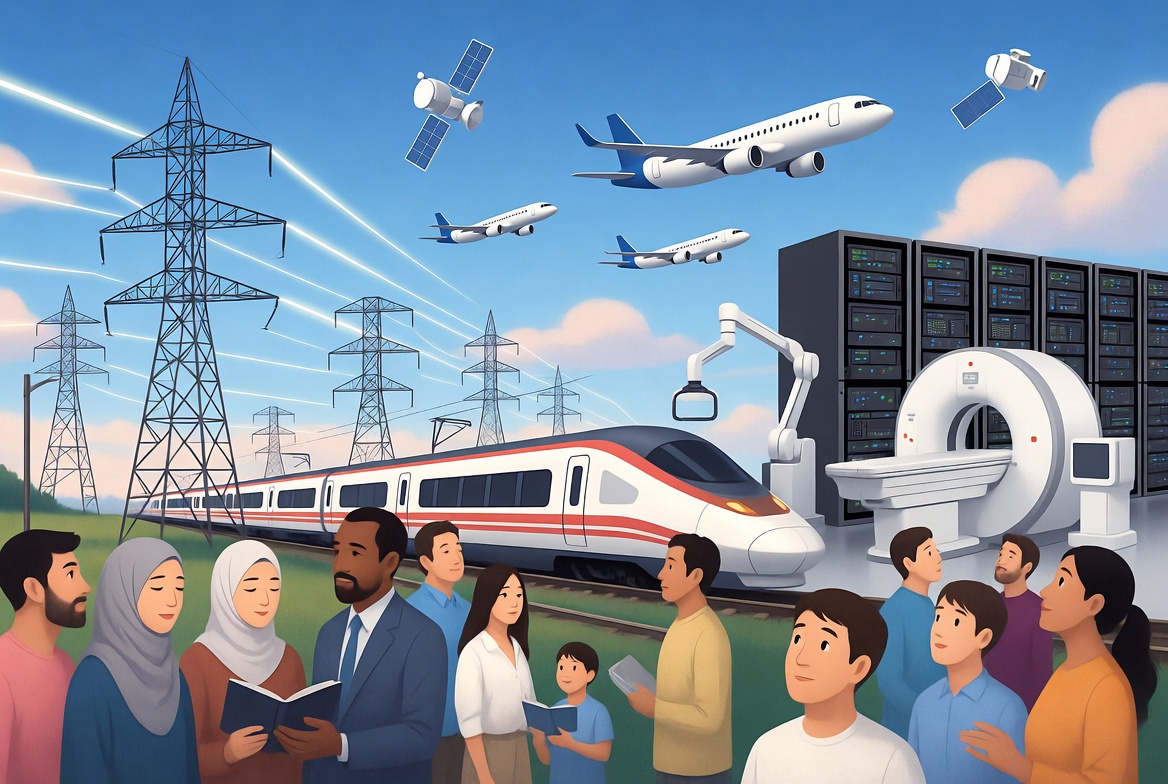
A single switch illuminates a room instantly. Refrigerators preserve food for weeks. Airplanes cross oceans in hours. Data centers process information at a scale unimaginable only decades ago. Yet most of us rarely think about the vast infrastructure required to make these conveniences possible.
We simply expect them to work.
This tendency extends far beyond electricity.
A smartphone grants access to more information than entire libraries once contained. Modern medicine cures diseases that routinely killed previous generations. Global logistics networks deliver products from one side of the planet to the other in days. Clean water arrives through pipes. Heating appears on demand. GPS guides us almost anywhere on Earth.
These achievements are so integrated into daily life that they have become invisible.
Progress has a strange characteristic.
The more successful it becomes, the less noticeable it is.
People celebrate breakthroughs.
They quickly normalize them.
Then they begin focusing on the next challenge.
This process is understandable.
Human beings adapt remarkably quickly.
Yet adaptation sometimes causes us to forget how extraordinary our circumstances actually are.
The historian Deirdre McCloskey often points out that for most of history, ordinary people lived near subsistence levels. Economic growth was not guaranteed. Improvements in living standards occurred slowly, if at all. The dramatic rise in prosperity that occurred over the past two centuries represents one of the most important transformations in human history.
And yet many people know surprisingly little about how it happened.
Industrialization.
Scientific discovery.
Public health.
Engineering.
Energy abundance.
Education.
Entrepreneurship.
Institutions.
The modern world emerged through the accumulation of countless innovations, large and small.
No single inventor created modern civilization.
Millions of people contributed to it.
Engineers improved machines.
Scientists expanded knowledge.
Entrepreneurs commercialized ideas.
Workers built infrastructure.
Teachers transmitted knowledge.
Each generation inherited progress from the previous one and added something new.
This perspective becomes particularly important when discussing the future.
Many public conversations focus almost exclusively on risks. New technologies are often evaluated primarily according to potential dangers. Caution is necessary and responsible. Every transformative technology creates new challenges.
Yet history suggests something equally important.
Progress deserves attention too.
Not blind optimism.
Not technological worship.
Simply recognition that humanity has repeatedly demonstrated an extraordinary ability to improve its circumstances.
The average person today lives longer, healthier and more comfortably than even the wealthiest individuals of previous centuries.
That achievement should not be dismissed.
It should be understood.
Living in California has reinforced this lesson.
Many of the technologies currently being developed may succeed.
Many will fail.
History will decide which innovations ultimately matter.
Yet regardless of the outcome, I am often reminded that today’s innovators are participating in a process much older than Silicon Valley itself.
The process of expanding human possibility.
The process that brought electricity, sanitation, vaccines, aviation, computing and the internet into existence.
The process that transformed humanity from a species struggling against scarcity into one capable of discussing settlements on Mars and artificial intelligence.
Progress is not inevitable.
It requires effort.
It requires institutions.
It requires builders.
It requires people willing to solve problems.
Most importantly, it requires societies capable of recognizing the value of improvement itself.
Perhaps that is why studying progress matters.
Not because it tells us exactly what the future will look like.
But because it reminds us how far humanity has already come.
We spend so much time looking toward the next breakthrough that we rarely stop to appreciate the civilization we have already built.
We no longer notice the miracles.
That may be one of the greatest luxuries progress has ever given us.
