The rise of physical AI
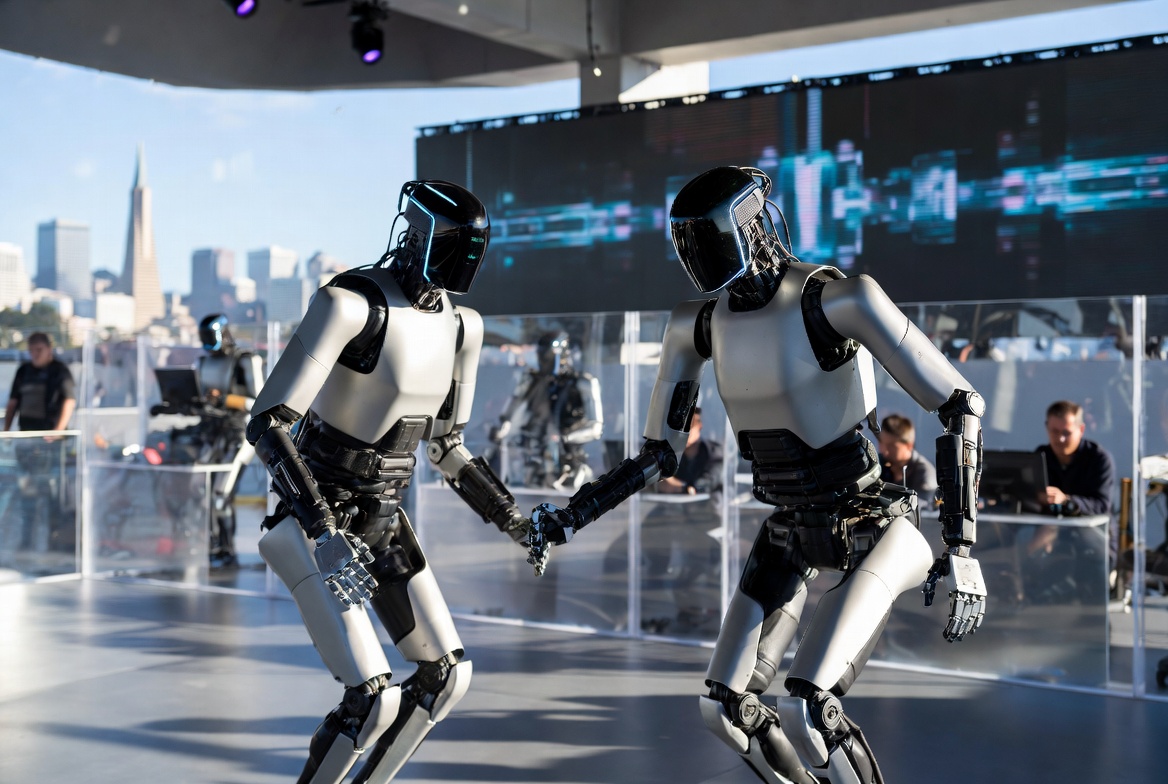
For much of the last decade, artificial intelligence lived on screens. We experienced it through search engines, recommendation systems, copilots, chatbots and increasingly capable software interfaces. Intelligence was something that processed language, generated images, summarized documents or wrote code. It felt digital, abstract and weightless. Yet spending time in San Francisco over the past year has made one thing increasingly clear to me: AI is beginning to leave the screen and enter the physical world.
This transition is no longer theoretical. In Silicon Valley, it is visible in conferences, robotics demos, startup events and even in the strange new entertainment formats emerging around humanoid machines. Since late 2025 and early 2026, new robot-fighting leagues have started to organize public matches with humanoid robots. Two names stand out in this small but revealing scene: REK, short for Robot Entertainment Kombat, and UFB, Ultimate Fighting Bots. At first glance, these events look like science fiction mixed with performance art. Human pilots control humanoid robots, spectators gather around a ring, and machines dressed almost like characters punch, dodge and stumble through early versions of robotic combat. It is imperfect, sometimes awkward, often funny, but also deeply revealing.
What matters is not whether the robots fight beautifully today. They do not. What matters is that a new relationship between humans, machines and physical intelligence is being tested in public. REK has been building a more permanent presence in San Francisco, including a space on Van Ness Avenue designed as a workshop, showroom and demonstration venue for humanoid robot fighting. UFB has also begun turning robot combat into a live spectator format, with events such as its May 14, 2026 “Fight x Dance” event at Temple San Francisco. These are not yet mainstream sports, and they are not yet evidence of fully autonomous humanoids. But they are signals. They show that robotics is moving from laboratories and corporate demos into culture.
Watching these events, one quickly understands why the phrase “physical AI” has become so important. Jensen Huang and Nvidia have repeatedly framed robotics and embodied intelligence as one of the next major frontiers of artificial intelligence. The idea is simple but profound. The first major wave of AI learned to understand and generate information. The next wave will increasingly need to perceive, move and act in the real world. That shift changes the entire nature of the problem. A chatbot can make a mistake and regenerate an answer. A robot operating in a warehouse, a hospital, a factory or eventually a home must deal with physics, safety, latency, uncertainty and human behavior.
This is why humanoid robot fights, despite their spectacle, are more interesting than they first appear. They expose the gap between digital intelligence and embodied intelligence. A language model can appear brilliant inside a browser window, but a robot must balance, respond, coordinate movement, interpret sensory input and interact with an environment that does not pause for computation. The physical world is messy. Floors are uneven. Objects move. Humans interrupt. Sensors fail. Wireless connections fluctuate. Batteries drain. Motors overheat. The transition from software AI to physical AI requires solving problems that cannot be solved by models alone.
It also explains why edge computing is likely to play a central role in this future. Physical AI cannot depend entirely on distant cloud infrastructure. A humanoid robot, an autonomous vehicle or an industrial machine often needs to make decisions locally and immediately. Latency becomes a safety issue, not merely a user experience issue. Connectivity cannot always be guaranteed. Data may be too sensitive or too voluminous to send continuously to the cloud. If intelligence is going to operate in the physical world, part of that intelligence must live close to the machine itself.
This makes the rise of physical AI an infrastructure story as much as a robotics story. Every intelligent machine requires compute. Compute requires energy. Energy generates heat. Hardware requires maintenance. Software requires updates. Networks require reliability. What appears publicly as a robot demo is actually the visible surface of a much deeper infrastructure stack. That stack includes chips, batteries, sensors, actuators, operating systems, edge servers, cloud platforms, simulation environments and training pipelines. The humanoid robot is not a standalone object. It is the endpoint of an entire technological ecosystem.
Tesla’s Optimus is perhaps the most visible example of this broader shift. Whether one is optimistic or skeptical about Tesla’s timeline, the direction is clear: major technology companies are now investing seriously in general-purpose humanoid robots. Startups such as Figure AI, Agility Robotics and others are pursuing related ambitions. Nvidia is building simulation and robotics platforms. Google DeepMind continues to work on models that connect perception, reasoning and action. The industry is converging around the idea that AI will not remain confined to text and images. It will eventually operate machines.
San Francisco is an ideal place to observe this transition because the city has a peculiar ability to turn early technologies into public experiments. Autonomous vehicles were tested here before most cities had any meaningful relationship with them. Delivery robots appeared on sidewalks before the average person understood the economics behind them. Now, humanoid robots are beginning to appear not only in corporate videos, but in public events, showcases and strange cultural formats like robot fight nights. These events may feel marginal today, but they often reveal where attention is moving before formal markets fully emerge.
Of course, physical AI remains early. The robots are still slow. Many systems remain teleoperated. True autonomy in open-ended environments is enormously difficult. The economics are uncertain. Safety standards will matter. Regulation will matter. Public trust will matter. It would be naïve to assume that humanoids will flood the streets tomorrow simply because a few compelling demos exist today. Robotics has disappointed optimists many times before.
But it would also be a mistake to ignore what is changing. The building blocks are improving at the same time: AI models, sensors, batteries, simulation tools, chips and edge infrastructure. When multiple enabling technologies improve together, progress can appear slow for years and then suddenly accelerate. This is what makes the current moment worth watching. Physical AI is not only about robots becoming better. It is about the surrounding ecosystem becoming ready for them.
The deeper significance of robot combat in San Francisco is therefore not entertainment. It is experimentation. These events compress many of the questions that will define the next decade of robotics. How do humans control machines? How do machines perform under pressure? How do audiences emotionally relate to robots? What happens when physical AI becomes social, competitive and visible? Before a technology becomes normal, it often becomes strange. Robot fights may be one of those strange early forms.
The first era of AI taught machines to process information. The next era may teach them to participate in the physical world. That future will not arrive all at once. It will come through warehouses, factories, laboratories, hospitals, retail stores, entertainment venues and eventually homes. Some applications will be useful. Some will be absurd. Some will fail. But the direction is becoming clearer.
Artificial intelligence is no longer only something we type into. Increasingly, it is something we will watch move through space.
