Building AI infrastructure between Europe and Silicon Valley
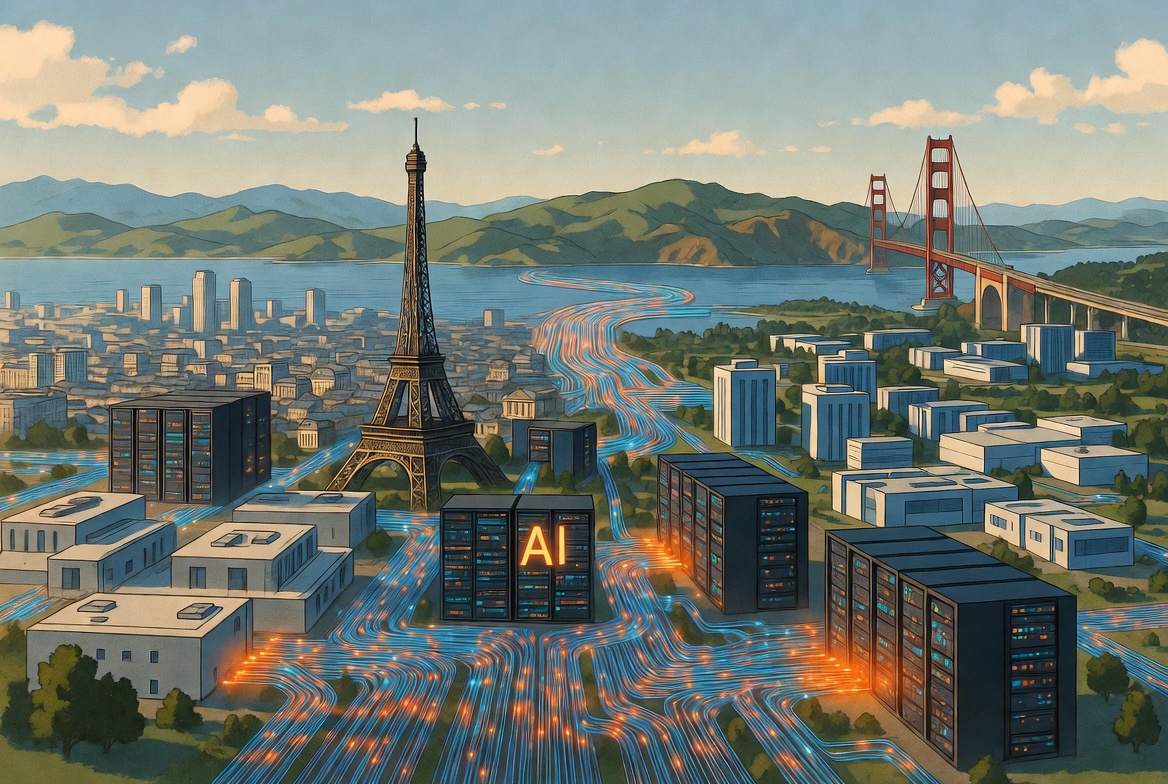
Moving from France to Silicon Valley changed the way I think about technology.
Before arriving in California, I viewed artificial intelligence primarily through the lens of applications, innovation and digital transformation. Like many Europeans working in technology, I followed the rapid evolution of AI models, cloud computing and enterprise software. Yet spending time inside the Silicon Valley ecosystem revealed a different reality. Behind every discussion about artificial intelligence lies a deeper conversation about infrastructure.
This observation has become increasingly difficult to ignore. Whether speaking with startup founders, attending conferences, meeting investors or visiting technology campuses, the same themes appear repeatedly: energy, compute, semiconductors, data centers and industrial capacity. The companies shaping the future of AI are not only building software. They are building the physical systems required to support intelligence at scale.
From a European perspective, this raises important questions.
Europe possesses world-class universities, exceptional engineering talent and a long history of industrial innovation. Yet when it comes to digital infrastructure, the continent often finds itself reacting to trends rather than shaping them. The internet era was largely defined by American technology companies. Cloud computing followed a similar pattern. Artificial intelligence risks producing the same outcome unless Europe develops a stronger strategic vision around infrastructure.
The challenge is not simply about creating more AI startups. It is about understanding where long-term value is created. Silicon Valley provides an interesting lesson in this regard. While public attention often focuses on consumer products, much of the ecosystem’s energy is directed toward foundational technologies. Semiconductor companies, infrastructure providers, networking firms and energy innovators play a central role in shaping the future. There is a recognition that breakthrough applications ultimately depend on underlying systems.
Artificial intelligence is making this relationship even more apparent. Every model requires compute. Compute requires hardware. Hardware requires energy. Energy requires infrastructure. As AI scales, these dependencies become increasingly important. The future of intelligence may therefore depend not only on software innovation but also on a society’s ability to build and operate complex infrastructure systems.
Europe is not starting from zero. The continent possesses important advantages. It remains a global leader in industrial engineering, energy systems, advanced manufacturing and sustainability. These capabilities may prove increasingly valuable as artificial intelligence moves beyond software and into the physical world. Intelligent factories, autonomous industrial systems, smart energy networks and edge computing deployments all require expertise that Europe already possesses.
At the same time, significant challenges remain. Infrastructure projects often move slowly. Regulatory complexity can discourage experimentation. Capital markets are generally less aggressive than their American counterparts. Building globally competitive technology ecosystems requires not only talent but also speed, ambition and long-term investment.
One of the most striking aspects of Silicon Valley is its willingness to think in decades. Conversations frequently revolve around technologies that may require years to mature. Investors support infrastructure projects with long development cycles. Founders pursue ambitious ideas despite significant uncertainty. This mindset creates an environment where transformative technologies can emerge.
Europe does not need to copy Silicon Valley. The regions possess different strengths, histories and priorities. Yet there are lessons worth studying. In particular, the AI era may reward societies capable of combining technological innovation with infrastructure development. Software alone will not be enough. Neither will regulation. Long-term competitiveness will depend on building systems that connect energy, computing, manufacturing and talent.
This perspective is one reason I remain optimistic about Europe’s role in the future of artificial intelligence. The conversation often focuses on what Europe lacks compared to the United States. A more interesting question concerns what Europe can uniquely contribute. Sustainability, industrial expertise, advanced engineering and infrastructure resilience may become increasingly important as AI continues to scale.
The future of artificial intelligence will not be decided solely by the largest models or the biggest technology companies. It will also be shaped by the infrastructure supporting those systems. Data centers, energy networks, semiconductors, cooling technologies and edge computing architectures will all play a role. In many of these areas, Europe possesses valuable capabilities that deserve greater attention.
Living between Europe and Silicon Valley has reinforced a simple belief. The AI revolution is not only a software revolution. It is an infrastructure revolution. The countries and regions that understand this distinction early will be better positioned to shape the future rather than simply adapt to it.
The next decade will not belong exclusively to those who build intelligence.
It may belong equally to those who build the infrastructure that makes intelligence possible.
