NVIDIA: The Company Powering the AI Revolution
- 4 min read
A few years ago, most people knew NVIDIA for one thing: graphics cards.
For gamers, NVIDIA represented performance, cutting-edge GPUs, and the ability to run increasingly demanding video games. The company was respected, successful, and influential within the computing industry.
Today, NVIDIA has become something entirely different.
It has become the company powering the artificial intelligence revolution.
Living in Silicon Valley, it is almost impossible to spend a day without hearing NVIDIA mentioned. Founders talk about NVIDIA. Investors talk about NVIDIA. Engineers talk about NVIDIA. Startup pitches mention NVIDIA. Product roadmaps depend on NVIDIA. Entire business models are built around gaining access to NVIDIA hardware.
The company’s rise has been extraordinary.
As artificial intelligence moved from research labs into mainstream adoption, NVIDIA found itself at the center of the most important technological shift of the century. The GPUs originally designed for graphics processing became the engines powering large language models, AI agents, robotics, autonomous systems, and next-generation computing.
Today, nearly every major AI company depends on NVIDIA infrastructure.
From small startups training their first models to technology giants investing billions into AI factories and hyperscale datacenters, everyone is competing for the same resource: compute power.
And increasingly, that means NVIDIA.
What fascinates me most is how NVIDIA has become much more than a hardware company.
In Silicon Valley, being part of the NVIDIA ecosystem carries enormous credibility. Partnerships, accelerator programs, certifications, and technical collaborations with NVIDIA are often viewed as strong signals of legitimacy and technical excellence. For many startups, especially those operating in artificial intelligence, infrastructure, robotics, and deep technology, an NVIDIA relationship has become a powerful validation mechanism.
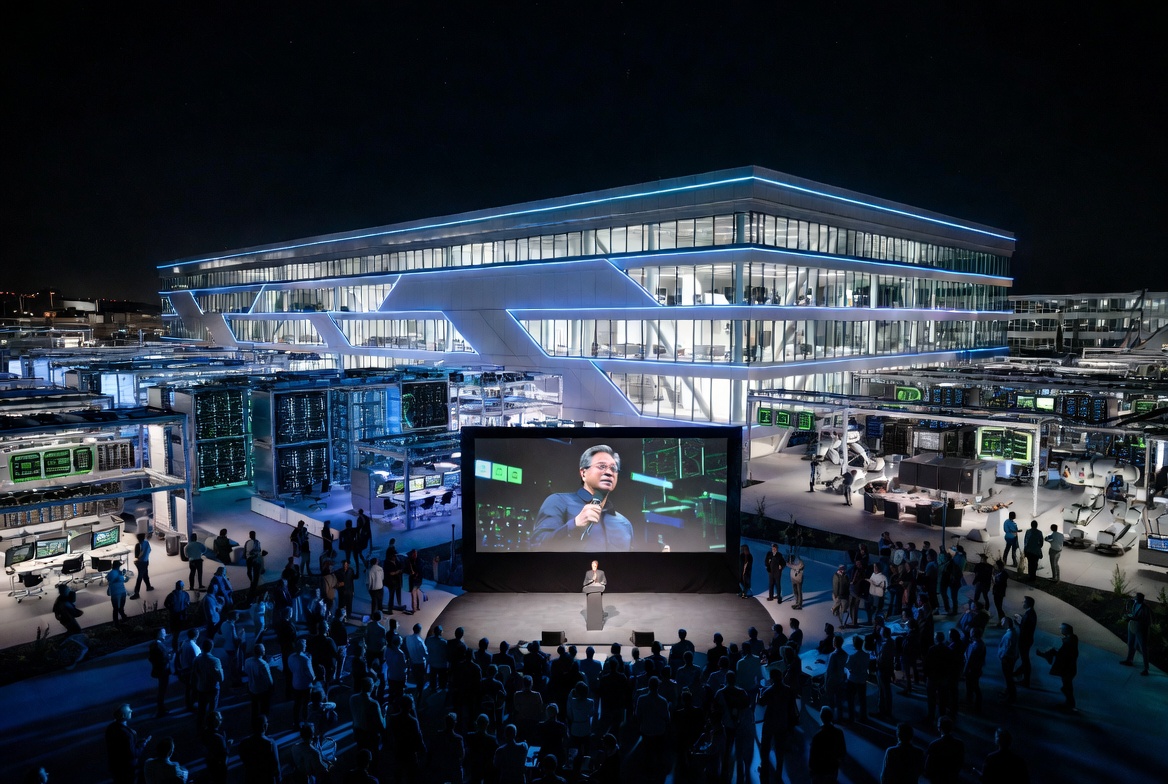
I had the opportunity to attend NVIDIA GTC in Silicon Valley this year, and it was one of the most impressive technology events I have experienced since arriving in California. Seeing Jensen Huang speak in person was particularly memorable. Beyond the product announcements and technical demonstrations, what stood out was his ability to articulate a vision for the future of computing, artificial intelligence, robotics, and infrastructure.
What makes Jensen Huang unique is that he has become much more than the CEO of a technology company. He has become one of the defining voices of the AI era. Following his journey from within Silicon Valley, I have come to appreciate how engaged he remains with the broader innovation ecosystem. Whether speaking at conferences, meeting founders, visiting universities, or engaging directly with engineers and students, he consistently demonstrates an accessibility and authenticity that is increasingly rare among leaders of companies of this scale.
There is also a strong sense of admiration for him throughout Silicon Valley. Not only because of NVIDIA’s success, but because of the culture he has built over decades. Long-term thinking, technical excellence, curiosity, humility, and relentless execution have become synonymous with both NVIDIA and Jensen Huang himself.
As someone working in AI infrastructure and sustainability, I see NVIDIA’s influence everywhere.
The future of artificial intelligence increasingly depends on compute, energy, cooling, networking, and infrastructure efficiency. Every major AI breakthrough ultimately requires physical infrastructure capable of supporting it. In many ways, NVIDIA sits at the center of that equation.
Beyond the technology itself, visiting NVIDIA’s campus in Santa Clara offers another perspective on the company’s success.
Like many iconic Silicon Valley campuses, the site reflects a culture built around engineering excellence and ambitious thinking. The architecture is modern, distinctive, and designed to encourage collaboration. The campus is beautiful both inside and outside, particularly at night when events, gatherings, and celebrations bring together engineers, founders, researchers, and innovators from across the technology ecosystem.
Walking through the campus, it is difficult not to feel inspired.
Not because of the buildings.
Not because of the valuation.
But because of the people.
Thousands of engineers, researchers, scientists, and innovators are working on technologies that will influence how humanity interacts with artificial intelligence for decades to come.
That realization is humbling.
It is also one of the reasons Silicon Valley remains so unique.
The world’s most influential technologies are not created by abstract institutions. They are created by individuals willing to spend years solving difficult problems that most people never see.
NVIDIA’s story is ultimately a reminder that technological revolutions are often driven by companies that initially appear to be solving entirely different problems.
A company once known primarily for gaming graphics now powers the global AI economy.
And from Silicon Valley, it feels like that story is only beginning.
