Why I’m Applying for the Knight-Hennessy Scholars Program at Stanford
- 4 min read
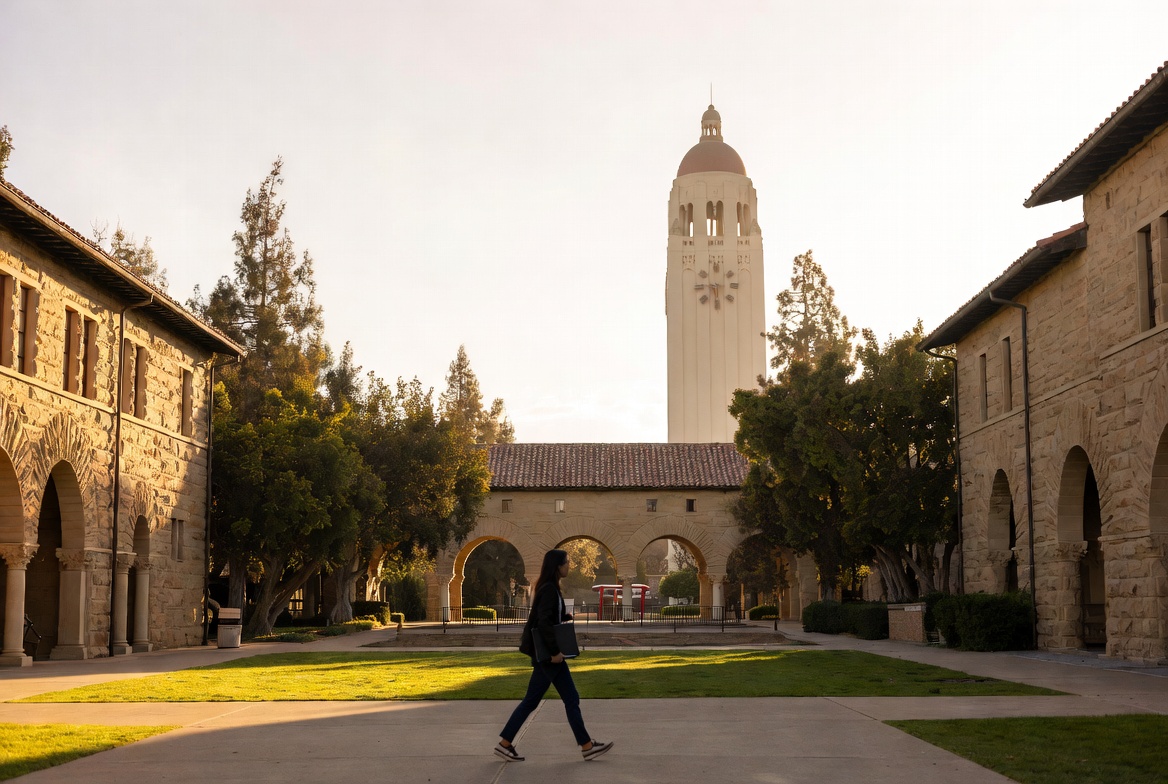
When people look at my profile today, they often see someone living in Silicon Valley, building a startup around sustainable AI infrastructure, volunteering in the San Francisco community, and applying to Stanford.
What they do not see is how unlikely that journey once seemed.
A few years ago, I failed my final high school examinations in France.
At the time, I felt disconnected from the educational system around me. I lacked direction, confidence, and a clear sense of purpose. Watching my classmates move forward while I remained behind was one of the most difficult experiences of my life. For a while, I genuinely believed I had fallen permanently behind.
Looking back, that failure became one of the most important moments of my life.
It taught me resilience.
More importantly, it taught me that success is not defined by where you start, but by your willingness to continue moving forward.
Over the following years, I built my career in digital infrastructure, datacenters, cloud computing, edge computing, and sustainable technology systems. I became fascinated by the invisible infrastructure powering our digital world and increasingly interested in a question I believe will define the next decade:
How do we ensure that the technologies transforming humanity remain sustainable enough to scale?
That question eventually brought me to Silicon Valley.
Over the past year, I have had the privilege of representing a French technology company in the United States, helping develop its presence in the American market while immersing myself in one of the world’s most dynamic innovation ecosystems.
Yet one of the most important lessons I learned in Silicon Valley had little to do with technology.
I live in the Tenderloin district of San Francisco.
Every day, I witness the contrast between extraordinary technological innovation and the very human challenges of poverty, homelessness, addiction, and social inequality. Through volunteering with the San Francisco-Marin Food Bank, participating in neighborhood initiatives, and contributing to discussions through Garry’s List, a civic organization founded by Garry Tan, CEO of Y Combinator, I have gained a deeper understanding of the complexity of urban challenges and the importance of civic engagement.
These experiences fundamentally changed how I think about leadership.
Innovation alone does not solve society’s problems.
Communities matter.
Institutions matter.
People matter.
My growing interest in the relationship between technology and society has also extended beyond Silicon Valley.
In 2024, I was selected to represent Iceland at the Change the World Model United Nations conference held at UNESCO Headquarters in Paris. As leader of the Icelandic delegation, I worked alongside participants from around the world on policy proposals addressing artificial intelligence, education, healthcare, and economic opportunity. Our Paris Accord for Human Development (PAHD), focused in part on responsible AI and human development, was ultimately adopted by majority vote.
More recently, I was selected for the Change the World World Program in New York, where I will continue engaging with future leaders committed to addressing global challenges through dialogue, policy, and international cooperation.
These experiences reinforced my belief that the most important challenges of our generation sit at the intersection of technology, policy, sustainability, and human development.
They also inspired me to launch CORE.
CORE is a project exploring how autonomous AI agents could optimize the energy consumption, efficiency, and sustainability of AI infrastructure. While much of the world focuses on AI models and applications, I have become increasingly convinced that the future of artificial intelligence depends equally on the infrastructure that powers it. As AI agents, robotics, and large-scale inference systems continue to expand, sustainable infrastructure will become one of the defining challenges of the coming decades.
Alongside CORE, I created Notebook from the Valley, a platform where I share reflections on artificial intelligence, innovation, entrepreneurship, sustainability, public policy, and life in Silicon Valley. I regularly participate in discussions and speaking engagements aimed at helping others better understand emerging technologies and their broader societal implications.
To me, technology is not an end in itself.
It is a tool.
A tool that can improve lives, strengthen communities, and help solve some of humanity’s most pressing challenges when guided by responsible leadership.
That is precisely why the Knight-Hennessy Scholars program resonates so strongly with me.
Knight-Hennessy is not simply about academic excellence. It is about bringing together people from different disciplines, cultures, experiences, and perspectives who share a commitment to creating positive change. The challenges that interest me most cannot be solved by engineers alone, entrepreneurs alone, or policymakers alone. They require collaboration across fields and across borders.
I am particularly drawn to Stanford because of its unique ability to connect technology, entrepreneurship, research, and public service. Over the past year, I have attended events focused on AI, innovation, energy, and entrepreneurship through organizations such as IEEE, BASES, and ASES. Each experience reinforced my belief that Stanford is one of the few places where ambitious ideas can be transformed into meaningful impact.
Whether or not I am ultimately selected for Knight-Hennessy, the application process has already encouraged me to reflect on a deeper question:
What kind of leader do I want to become?
The answer is becoming clearer.
I want to help build technologies that advance human progress while remaining sustainable, responsible, and accessible. I want to contribute to communities, not just companies. I want to bridge technology, policy, and human development. And I want to spend my career helping ensure that the next generation of innovation benefits society as a whole.
For me, Knight-Hennessy represents an opportunity to continue that journey.
