What Nvidia GTC, CES, Google I/O and Dell Technologies World reveal about the next decade of computing
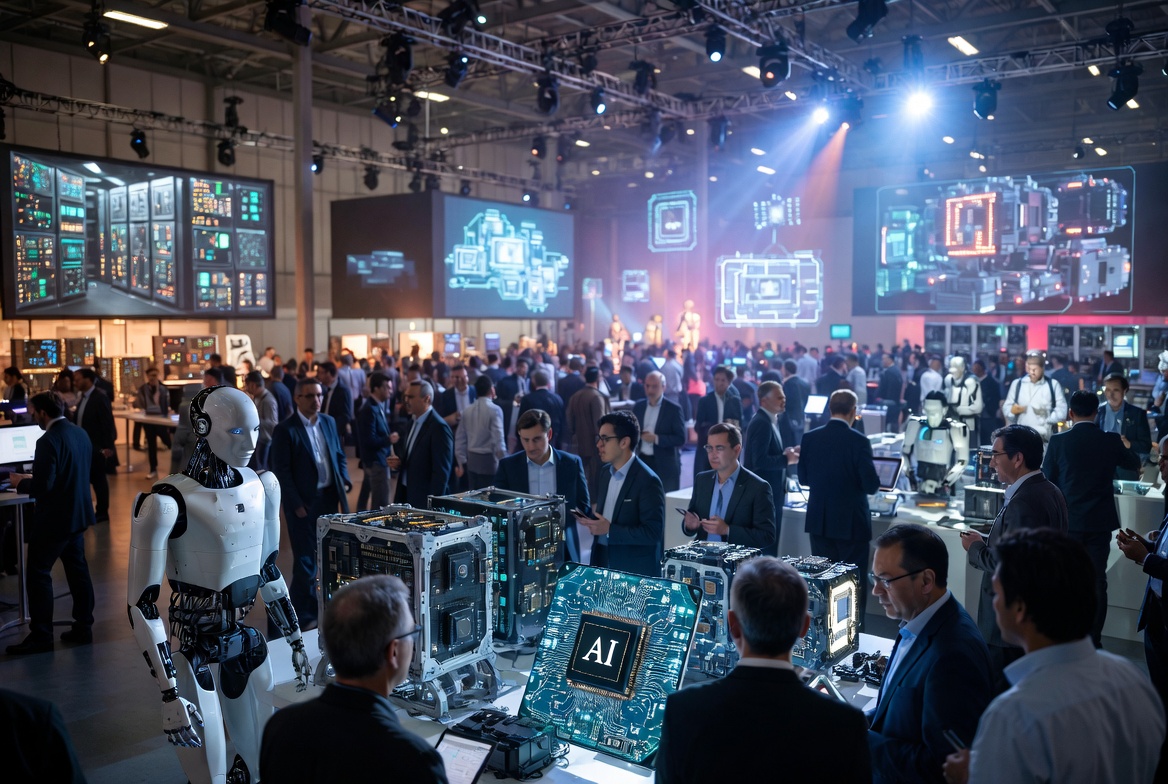
What Nvidia GTC, CES, Google I/O and Dell Technologies World reveal about the next decade of computing
4 min read
One of the advantages of spending time in Silicon Valley is being able to watch technology evolve before it becomes ordinary.
Over the past year, I attended several of the industry’s most influential gatherings, including CES in Las Vegas, NVIDIA GTC in San Jose, Google I/O in Mountain View, where I was invited by Google as a journalist, and Dell Technologies World in Las Vegas.
Each event had a different audience and a different emphasis. CES showed how AI is moving into products and machines. NVIDIA GTC focused on the infrastructure required to power the next generation of intelligence. Google I/O showed how AI is becoming embedded into everyday software and developer workflows. Dell Technologies World focused on the enterprise systems required to deploy all of this securely and at scale.
Taken together, they reveal something important: the next decade of computing will not be defined by AI models alone. It will be shaped by the systems around them.
From generative AI to agentic AI
At Google I/O 2026, one of the clearest shifts was from AI that simply responds to prompts toward AI that can increasingly take action.
Google introduced Gemini 3.5 Flash, positioned around fast, frontier-level performance and long-horizon agentic tasks, alongside a broader ecosystem of agent-oriented developer tools such as Google Antigravity. Bittide
This matters because it changes the role of AI.
The first wave of generative AI was largely about assistance: writing, summarizing, searching and coding. The next wave is increasingly about delegation. AI systems are beginning to operate tools, execute workflows and coordinate multiple tasks.
That transition was visible across nearly every major conference I attended.
The question is no longer simply: How intelligent is the model?
It is becoming: What can the system actually do?
Physical AI is becoming real
CES and NVIDIA GTC made the second shift even more visible: AI is moving into the physical world.
At CES 2026, Hyundai Motor Group presented a broader AI Robotics Strategy and demonstrated systems including Boston Dynamics’ Atlas and Spot, as well as MobED. The company explicitly framed its strategy around the emergence of Physical AI and announced work on low-power edge AI chips for robotics. Hyundai
At NVIDIA GTC, Physical AI was one of the central themes. NVIDIA announced new robotics and industrial AI initiatives, including an Open Physical AI Data Factory Blueprint, expanded robotics partnerships and new digital-twin infrastructure based on Omniverse. NVIDIA Developer Forums
This is a major change.
For much of the last twenty years, the technology industry was dominated by software running on screens.
The emerging phase is different.
AI is increasingly being embedded into robots, autonomous systems, factories, vehicles, warehouses and industrial equipment.
That means the future of AI will depend not only on models, but also on sensors, chips, networking, power systems and physical infrastructure.
Compute is becoming infrastructure
NVIDIA GTC made perhaps the strongest case that computing itself is becoming a strategic infrastructure layer.
The company continued to expand the transition from Blackwell toward Vera Rubin, its next-generation AI platform combining CPUs, GPUs, networking and rack-scale systems. NVIDIA has argued that the economics of AI should increasingly be measured not only in raw compute performance, but in metrics such as tokens per watt, tokens per dollar, utilization and time to production. Investing.com
That is an important shift in language.
A few years ago, most public discussion centered on model size and benchmark scores.
Today, the industry is talking about AI factories.
Behind every AI service now sits an increasingly complex physical stack:
GPUs.
CPUs.
Networking.
Storage.
Cooling.
Power.
Data centers.
The constraint is moving downward through the stack.
Enterprise AI is becoming local, hybrid and distributed
Dell Technologies World revealed another side of the same transformation.
For enterprises, AI is not simply a cloud problem.
Dell expanded its AI Factory portfolio with new PowerEdge systems supporting NVIDIA’s Vera Rubin architecture, new liquid-cooled systems capable of supporting very high GPU densities, and new local AI infrastructure designed for production workloads. Dell
One of the more important developments was the continued push toward private and on-premise AI.
Dell also highlighted integrations designed to bring models such as Google Gemini closer to enterprise data while addressing issues including sovereignty, privacy and control. Semiboard
This reinforces a trend I have observed repeatedly through my own work in edge computing and infrastructure:
the future of AI will not live entirely in hyperscale cloud data centers.
Some workloads will remain centralized.
Others will move into private data centers, enterprise infrastructure, edge systems and eventually devices themselves.
The architecture is becoming distributed.
Efficiency is becoming as important as capability
Across all four conferences, another word appeared repeatedly:
efficiency.
During the early generative AI boom, the industry was primarily focused on increasing capability.
Now the economic questions are becoming harder to ignore.
How much does inference cost?
How much electricity does the infrastructure consume?
How much cooling is required?
How effectively are GPUs being utilized?
How much data needs to move across networks?
Dell is already marketing systems in terms of cost-per-token improvements, while NVIDIA increasingly frames architecture around throughput per megawatt and token economics. Dell
The AI industry is entering a phase where engineering economics matter almost as much as model intelligence.
That may ultimately be healthy.
The systems that become dominant are rarely the ones that merely work.
They are the ones that can work reliably, efficiently and at scale.
The energy question is now unavoidable
Perhaps the most important shift I observed was how frequently conversations about artificial intelligence became conversations about electricity.
That would have seemed unusual at a software conference only a few years ago.
Today it is unavoidable.
AI data centers require enormous amounts of power. Higher-density systems require more advanced cooling. New AI factories require grid connections, transformers, substations and increasingly sophisticated energy management.
As computing becomes more powerful, the boundary between the technology industry and the energy industry is disappearing.
This may become one of the defining infrastructure challenges of the next decade.
We may discover that scaling artificial intelligence is not limited primarily by algorithms.
It may be limited by our ability to build the physical systems required to support them.
The next computing era is becoming visible
Taken together, CES, NVIDIA GTC, Google I/O and Dell Technologies World point toward the same direction.
AI is moving:
from chatbots to agents;
from software to physical systems;
from individual GPUs to AI factories;
from centralized cloud infrastructure to distributed computing;
and from raw capability toward efficiency and economics.
What makes this transition particularly interesting is that none of these developments exists independently.
More capable agents require more inference.
More inference requires more compute.
More compute requires more data centers.
More data centers require more energy.
Physical AI requires chips, sensors, networks and manufacturing.
Enterprise AI requires security, sovereignty and local infrastructure.
The future of computing is therefore becoming less about individual technologies and more about interconnected systems.
That may be the most important lesson from attending these conferences.
The next decade will not be shaped by a single model, company or breakthrough.
It will be shaped by the interaction between AI, hardware, infrastructure, robotics, energy and distributed computing.
